📍 Monte Porzio Catone (RM)📍 Monte Porzio Catone (Rome) ✉️ ilpomariodelpapa@gmail.com✉️ ilpomariodelpapa@gmail.com

History

“Hortus conclusus soror mea, sponsa, hortus conclusus, fons signatus.”
A garden enclosed is my sister, my spouse; a garden enclosed, a fountain sealed.
— Song of Songs, 4:12

The Barco Borghese, on the upper platform of a vast Roman-era terracing, is a place of twofold nature: below, the largest known complex of vaulted substructures — some two hundred chambers; above, a four-hectare esplanade that over the centuries alternated between hunting ground and orchard. It is here that the Pope’s Orchard lives again today.

What a “Barco” is

In the 16th and 17th centuries, the term “Barco” referred to the part of a great suburban villa that was enclosed by a wall and originally reserved for hunting. It was a fashion widespread among the great families: there was the Este Barco below Tivoli, the Medici Royal Barco, the ducal Barco of Ferrara. The enclosure set apart a world of its own, a tamed nature held within precise boundaries.

From the hortus conclusus to the pomarium

To this idea of an enclosed space belongs the tradition of the hortus conclusus, the “enclosed garden” of early-medieval origin which, through monastic mediation, reached the Renaissance garden laden with secular and religious symbolism. As the utilitarian section of the historic garden (viridarium), the pomarium — the orchard — developed, often preserving the enclosed geometric form with a cross-shaped layout and, at its centre, a fountain or the tree of life. The ducal pomarium of Massa and the episcopal one of Bolzano are well-known examples: to this type the Barco’s orchard also belongs.
1567 · The origins

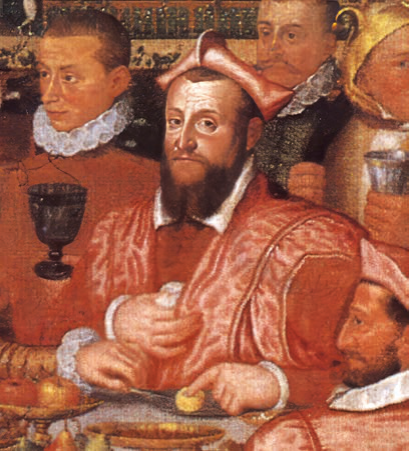
Cardinal Marco Sittico Altemps

It all begins in 1567 thanks to a singular figure, Marco Sittico Altemps, member of a noble family from western Austria (ab alta Ems), a man of arms in his youth, later Cardinal at the Papal Court, where he latinised his name.

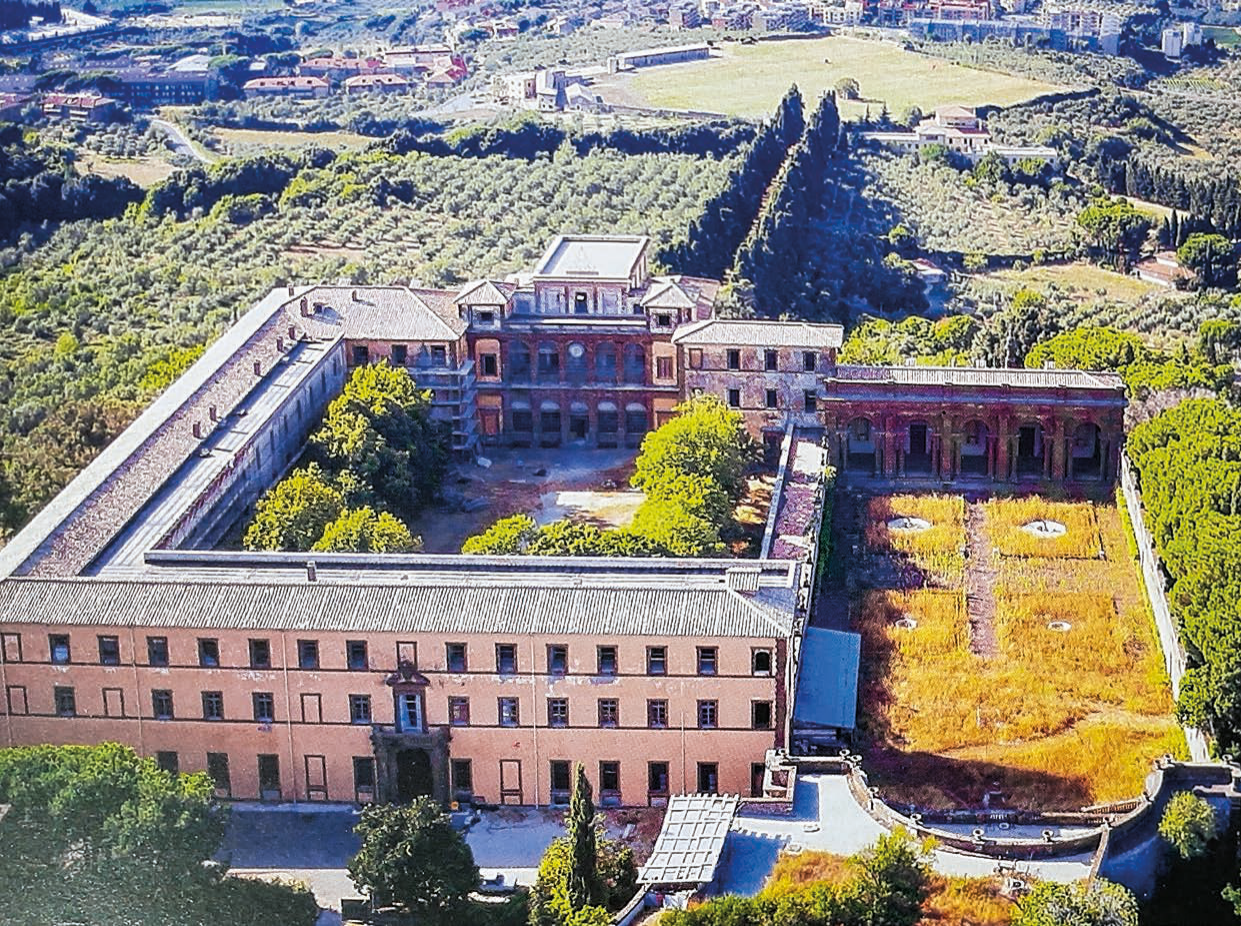
On the Tusculan hill — where he takes over a Farnese property, Villa Angelina, enlarged to a design by Vignola and renamed Villa Tuscolana — he is faced with a great four-hectare esplanade, strewn with ruins and bearing a monumental front known as “the high grottoes”: the mark of a vast artificial terracing of Roman age. Altemps has the esplanade enclosed, restoring the ancient perimeter wall, builds a farmstead and a stable along its edges, and adapts it into a Barco.

Il cardinale Marco Sittico Altemps
1613 · The Burghesianum

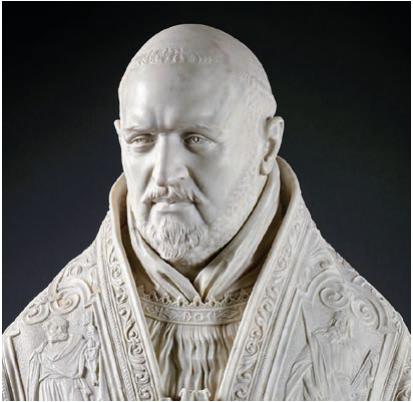
Paul V Borghese and the Burghesianum

In 1573 Altemps begins the construction of Villa Mondragone, the work of Martino Longhi the Elder. In 1613 villa and Barco pass to Pope Paul V Borghese and his nephew, Cardinal Scipione, together with Villa Vecchia (formerly Tuscolana) and the nearby Villa Taverna. Vasanzio is the architect of this splendid new building phase.

Thus is born the Burghesianum, the most extraordinary complex of suburban villas in the Europe of the time: the Barco, fitted with a new portal, alternates between hunting ground and orchard, a vocation that would ultimately prevail.

Papa Paolo V Borghese
The composition

The “perspective telescope”

The perspective axis starts from Villa Mondragone, crosses the entrance avenue and ends at the Barco: the mark of a grand composition on a territorial scale. This “perspective telescope” has two focal points, corresponding to two monumental fountains — the Dragons’ Fountain on Mondragone’s great terrace and the Barco fountain, perhaps both by Vasanzio.

Once inside the Barco, the perimeter wall — taller than a human figure — blocks the view outward, heightening the sense of enclosed space: the gaze opens toward Rome and the Roman Campagna only at the end of the central spine. A skilful staging for an emotional crescendo.

L'asse prospettico tra villa Mondragone e il Barco
Timeline

Five centuries at a glance

From the 16th-century origins to the rebirth of the orchard.

1567

The Barco is born

Cardinal Marco Sittico Altemps purchases and enlarges Villa Angelina, formerly a Farnese property; he encloses the great four-hectare esplanade and adapts it into a Barco.

1573

Villa Mondragone

Altemps begins the construction of Villa Mondragone, the work of Martino Longhi the Elder.

1613

The Burghesianum

Pope Paul V Borghese, with his nephew Scipione, acquires Mondragone, Villa Vecchia, Villa Taverna and the Barco: the “Burghesianum” is born. The Barco alternates between hunting ground and orchard.

1626

The papal court to Castel Gandolfo

Urban VIII Barberini gives up Villa Mondragone as a papal residence, transferring it to Castel Gandolfo.

1755

Voltaire’s “Zaïre”

The last great society event at Villa Mondragone: the performance of Voltaire’s “Zaïre”; the decline begins.

19th c.

Neglect and losses

Villa Mondragone goes through periods of neglect and destruction; Camillo Borghese sells the sculpture collection to the Louvre; the new carriage road between Frascati and Monte Porzio breaks the continuity with the Barco.

late 19th c.

To the Jesuits

The Borghese family sells Villa Mondragone to the Jesuits (the Noble College of Mondragone) and Villa Borghese to the Parisi family; the Barco remains the heart of the Mondragone farm estate.

early 1900s

Grossi Gondi and Ashby

Grossi Gondi and Thomas Ashby explore the “high grottoes”; Ashby draws the first plan of the substructures.

post-war

The mushroom farm

The substructures are leased to a mushroom farm that conceals them with sheeting; the orchard is abandoned. The Jesuits close the Noble College.

1981

Tor Vergata at Mondragone

The University of Rome “Tor Vergata” purchases Villa Mondragone.

1990s

The rediscovery

With the purchase by the “Il Parco” cooperative, the lease to the mushroom farm is terminated and some 200 vaulted chambers are rediscovered.

1997

Loan to the Municipality

Free-use loan to the Municipality of Monte Porzio Catone.

2000

Jubilee: first funds

With the Jubilee year come the first funds for the archaeological recovery.

2007

Opening to the public

The archaeological sector of the substructures opens to the public.

2022

NRRP call

The NRRP call “Historic parks and gardens” launches the recovery of the orchard.